
Spots on the dishes again, soap that will not lather, or a salt level that never seems to drop: these are signs your water softener has stopped doing its job. Most problems have simple causes you can check yourself in a few minutes before calling for service.
Key points
- Start with the basics: power, bypass valve, salt level and the clock or settings.
- A salt bridge, a hard crust that forms above the water in the brine tank, is one of the most common causes of hard water returning.
- Salt mushing, a clogged brine injector (venturi) and worn or iron-fouled resin are the next things to check.
- Call a technician for valve motor, timer or control board failures.
Step 1: Check the basics
- Power: make sure the unit is plugged in, the outlet works and the display is on. After a power outage, reset the time of day so regeneration happens at night.
- Bypass valve: confirm the bypass is in the “service” position, not “bypass.” It is easy to leave it open after maintenance.
- Settings: check that the hardness setting matches a recent water test. If your water hardness changed, update it.
- Test the right tap: outdoor faucets and some cold kitchen lines are often plumbed to skip the softener.
Step 2: Look for a salt bridge
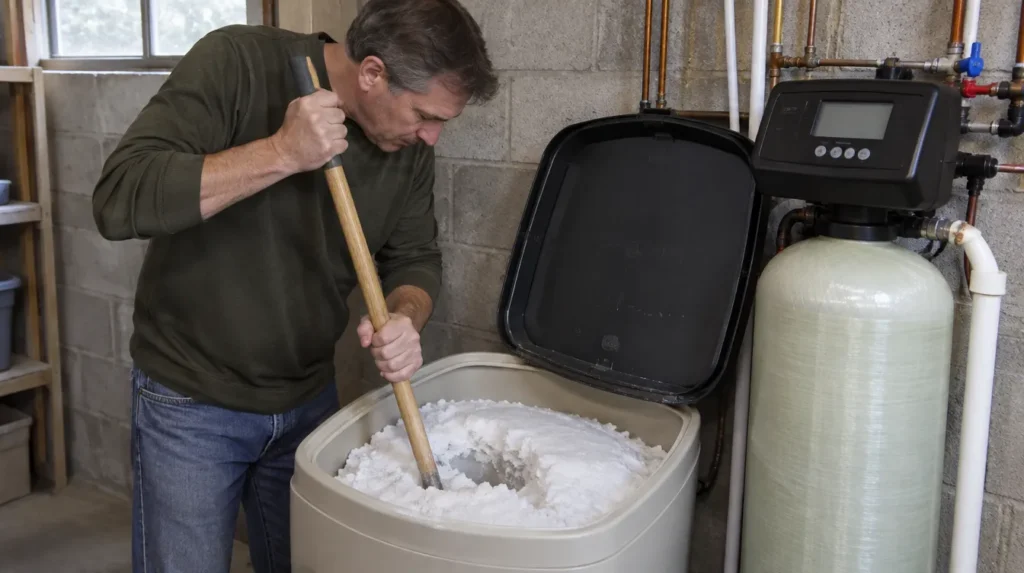
A salt bridge forms when salt fuses into a hard crust above the water in the brine tank. The tank looks full, but there is a hollow space underneath, so the water never touches the salt, no brine is made and the resin is not recharged. A salt level that does not go down over several weeks is the classic clue.
- Turn the softener to bypass.
- Push a broom handle gently down through the salt. If it hits a hard layer above the bottom of the tank, you have a bridge.
- Tap carefully around the crust until it breaks into pieces. Do not hit the tank walls hard.
- Remove large chunks if needed, then run a manual regeneration once the salt is back in contact with the water.
Humidity, overfilling the tank and lower-quality salt make bridges more likely. Keeping the salt only a few inches above the water helps. See how to choose water softener salt.
Step 3: Check for salt mushing
Salt mushing is a thick sludge of recrystallized salt at the bottom of the brine tank. It can block the brine line so the softener cannot draw brine. Mushing usually means the tank needs to be emptied and cleaned. Switching to a purer salt reduces the problem.
Step 4: Water in the brine tank
Some softeners keep a few inches of water in the brine tank at all times; others fill it only before regeneration. Check your manual. If the water level is much higher than normal, the brine line, injector or float may be clogged or stuck, and the softener is not drawing brine.
Step 5: Clean the injector (venturi)
The injector creates the suction that pulls brine into the resin tank. Sediment can clog it, especially if you use rock salt. Many manuals explain how to remove and rinse the injector screen and nozzle with the water supply turned off. If you are not comfortable taking it apart, a technician can do it during a service call.
Step 6: Resin problems
Resin beads last many years but can be fouled by iron or worn out over time. Signs include soft water that runs out sooner than it used to, or brown water and tiny beads appearing in faucets. Iron-fouled resin can sometimes be cleaned with a resin cleaner made for softeners; worn resin needs replacing.
When to call a technician
- The display shows an error code or the control valve does not cycle.
- You hear the motor running but regeneration never completes.
- Water is leaking from the valve or tanks.
- Resin beads are appearing in your plumbing.
- The unit is old and repairs would cost close to a new, more efficient model.
If you are considering a replacement, our guide on how water softeners work and how to size one explains what to look for.
Sources
- Culligan: Water Softener Troubleshooting
- Angi: 4 Clogged Water Softener Reasons and How to Fix Them
- Sears PartsDirect: Water Softener Not Using Salt
- Fresh Water Systems: Water Softener Maintenance 101
This guide is general information. Unplug the unit and turn off the water supply before opening any part of the control valve, and follow your manufacturer’s instructions.