
Whether you are building a house, buying one with a septic system or wondering why your tank seems to fill up fast, tank size matters. It decides how much wastewater the system can hold, how long solids have to settle and how often the tank needs pumping. Here is how septic tanks are sized and what the common sizes are.
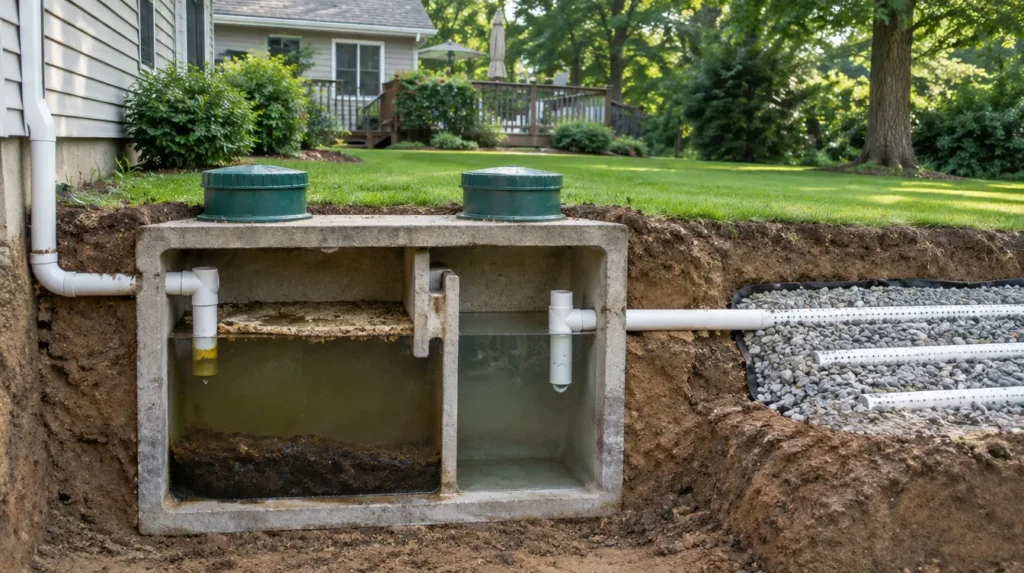
Key points
- Septic tanks are sized by the number of bedrooms, not by square footage or the number of people living in the house.
- Many states require at least 1,000 gallons for a typical three-bedroom home.
- Minimum sizes differ from state to state, so your county health department has the final word.
- A bigger tank does not mean you can skip pumping, but it can stretch the time between pump-outs.
Why bedrooms, not people?
Codes size septic tanks by bedrooms because the number of people living in a house changes over time, while the number of bedrooms rarely does. Virginia, for example, assumes each bedroom will be occupied by two people when it sets tank sizes. The University of Nebraska–Lincoln notes that tank size is not based on the square footage of the house or the number of occupants, because occupancy can change.
Common septic tank sizes by bedroom
These are minimum liquid capacities from a few state codes. They show how much the rules can vary:
| Bedrooms | Minnesota | Nevada | Washington | Virginia |
|---|---|---|---|---|
| 1 to 2 | 1,000 gal | 1,000 gal | 1,000 gal | 750 gal |
| 3 | 1,000 gal | 1,000 gal | 1,000 gal | 900 gal |
| 4 | 1,500 gal | 1,200 gal | 1,000 gal | 1,200 gal |
| 5 | 1,500 gal | 1,500 gal | 1,250 gal | 1,500 gal |
Minimums taken from state rules and extension publications listed in the sources. Washington adds 250 gallons for each bedroom over four. Always confirm the current rule with your local health department.
In practice, most homes have tanks between 1,000 and 1,500 gallons. Some states also add capacity for features that send a lot of water at once. Nebraska, for example, adds 250 gallons for a whirlpool bath.
How to find your tank size
- Check the permit. Your county health department or environmental health office usually keeps the original permit and site drawing, which lists the tank size.
- Ask the pumping company. The report from your last pump-out often lists the gallons removed or the tank capacity.
- Look for a label. Some concrete and plastic tanks have the capacity stamped near the access opening.
- Ask an inspector to measure it. A septic professional can estimate the volume from the tank dimensions.
Does tank size change how often you pump?
Yes. A larger tank holds more sludge and scum before it reaches the level where it needs pumping. The EPA suggests pumping a typical household tank every three to five years, but the right interval depends on household size, total wastewater, the amount of solids and tank size. A family of five on a 1,000-gallon tank will need pumping more often than a couple on the same tank. Larger tanks also cost more per pump-out; see septic tank pumping costs by tank size.
Adding bedrooms or a remodel
If you plan to add a bedroom, finish a basement with sleeping space or convert a garage, check with the health department first. Because systems are sized by bedrooms, many areas require a permit review and sometimes a larger tank or drainfield before the addition is approved.
Tank materials
- Concrete: heavy and durable, the most common choice for new installations.
- Polyethylene (plastic): lightweight and easier to install where access is tight, but must be installed carefully to avoid floating when groundwater is high.
- Fiberglass: light and corrosion-resistant.
- Steel: found in older systems; steel tanks rust and Nebraska Extension recommends replacing metal tanks when they are discovered.
To understand what happens inside the tank, read how a septic system works. The other half of sizing is the drainfield, explained in how a septic drain field works.
Sources
- Virginia Cooperative Extension: What to Know About Septic Systems When Building a House
- University of Nebraska–Lincoln Water: Septic Tank Design
- Minnesota Rules 7080.1930: Septic Tank Capacity
- Nevada Administrative Code 444.8306
- Washington WAC 246-272A-0232
- U.S. EPA: How to Care for Your Septic System
This guide is general information. Septic codes change and vary by state and county; your local permitting authority decides the size required for your property.